Tuesday, September 21, 2021

Alzheimer's Disease: Signs and Symptoms - HealthXchange

Alzheimer's Disease: Signs and Symptoms - HealthXchange

​​​Alzheimer's Disease: Signs and Symptoms

Alzheimer's disease is the most common form of dementia. The Department of Neurology at National Neuroscience Institute (NNI) shares some of the signs and symptoms to look out for.

Favourite

Dementia: Alzheimer's Disease, Signs and Symptoms
Alzheimer's

symptoms, especially during the mild stage, are not easy to recognise and can be confused with normal ageing.

Alzheimer's disease: Most common form of dementia

Alzheimer's disease is the most common form of dementia and accounts for about 70 per cent of all cases. In an Alzheimer's patient, the brain cells degenerate gradually and eventually die, causing memory loss and a decline in other mental functions which affect day-to-day functioning.

"There is no cure for Alzheimer's disease though there are drugs which can slow the progression of symptoms," shares Adjunct Associate Professor Shahul Hameed, Senior Consultant from the Department of Neurology at National Neuroscience I​nstitute (NNI), a member of the SingHealth​ group.

This progressive brain disease usually occurs in older people, with symptoms typically appearing after the age of 60. However, there are a small number of patients who may develop Alzheimer's early, between the ages of 30 to 60. This is known as early onset Alzheimer's.

There are three general stages of the disease – mild, moderate and severe – and it may take years for the patient to progress from one stage to the next. Research suggests that the changes in the brain related to Alzheimer's can begin as much as a decade or more before symptoms first appear.

"The course of Alzheimer's differs from patient to patient but the disease is usually diagnosed at the mild stage. Alzheimer's causes brain cells to die and the affected brain regions to shrink in size. The damage is irreversible," says Adj Assoc Prof Hameed.

Signs and symptoms of Alzheimer's

The symptoms of Alzheimer's disease are not always easy to recognise and can be confused with normal ageing. One of the first signs of the disease is short-term memory loss with patients forgetting conversations and even where they live. Symptoms worsen at each stage of the disease.

The following ar​e common signs and symptoms of Alzheimer's:

Mild Alzheimer's

  1. Repeat questions
  2. Have difficulty remembering directions and recognising surroundings   
  3. Have trouble handling money, paying bills and balancing a cheque book
  4. Take more time than usual to complete daily tasks
  5. Misplace everyday items, often keeping them in inappropriate places, e.g. putting keys or reading glasses in the refrigerator
  6. Display mood and personality changes such as increased anxiety, restlessness and aggression
  7. Have poor judgement, e.g. wear warm clothing on a scorching day

Moderate Alzheimer's:

  1. Have long-term memory loss and forget their personal information such as name, occupation and date of birth
  2. Forget common words and the names of everyday objects
  3. Have trouble recognising family and friends
  4. Be unable to learn new things
  5. Have difficulty in carrying out tasks that involve several steps, e.g. bathing, getting dressed and cooking a meal
  6. Have trouble coping with new situations
  7. Experience hallucinations, delusions and become paranoid
  8. Display impulsive behaviour

Severe Alzheimer's

  1. ​​​Be unable to communicate
  2. Groan and grunt
  3. ​Have trouble swallowing food and eating
  4. Have lack of control of bladder and bowels
  5. Sleep most of the time
  6. Develop skin infections

"In the final stage of the disease, Alzheimer's patients may be bedridden and completely dependent on caregivers," says Adj Assoc Prof Hameed.​

​See page 2 to learn about the causes of Alzheimer's, and how the condition is diagnosed and treated.

See page 3 to learn find out how sundowning (or sundown syndrome) affects Alzheimer's patients.
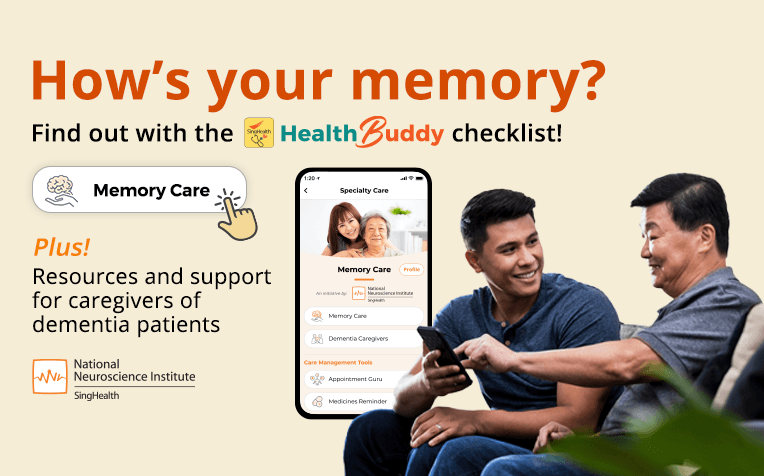
Tap the banner above to find out how Memory Care on the Health Buddy app can help you maintain or improve your memory. Plus, get tips on how to care for a loved one with dementia.

Ref. S1​3

Check out more articles on brain diseases:

How to Detect Brain Diseases Early (Stroke, Parkinson's, Dementia, Eplilepsy)

Tips to Prevent Dementia

Dementia Caregiver Tips: Understanding Dementia Behaviours

Parkinson's: Common Misconceptions Tackled!

YOD: Dementia That Affects the Young

Contributor(s):

For HealthXChange

​​Terms of Use / Disclaimer
All information provided within this web and mobile application is intended for general information and is provided on the understanding that no surgical and medical advice or recommendation is being rendered. Please do not disregard the professional advice of your physician.​

Sharing is caring!


Sent from my iPhone

Friday, August 20, 2021

From Mrs. Ameena Essa.


--
Hello,

How are you doing today?
I sent you an email yesterday, did you receive it? It is a very
important message, anyway reply back to confirm that you already got
my message to enable me to give you more details..

Best Regards.
Mrs. Ameena Essa

Thursday, August 5, 2021

Metacognition and Mindfulness Meet the Power of Not Yet! | Getting Smart

Metacognition and Mindfulness Meet the Power of Not Yet! | Getting Smart

Metacognition and Mindfulness Meet the Power of Not Yet!

Teachers today are often faced with the challenge of students who just "give up" at the first sign of an academic challenge. They commonly hear things like "I don't know how to do this", "You didn't teach us this", " I can't do this" and "I am too stupid to do this". The student who will verbalize his/her thoughts allows the teacher to try to help him/her find success. Too often, however, students become academically frustrated and will act out in the classroom or just sit there and do nothing and say nothing. Students often lack the academic resiliency that comes from developing metacognition.

Metacognition is awareness and understanding of one's own thought processes. The ability to analyze one's own thoughts that lead to statements like "I don't know how to do this" and "I can't do this" allows for students to take better control of the learning and to begin to apply the skills and knowledge they have to the situation. Often times, if we begin to ask the student questions about what he/she does know how to do, what skills he/she has that can be applied, the student is then able to begin to attend to the work. However, what has often happened in the past, is that the student has been unsuccessful in attempting to do something new, gotten a grade that felt "bad" and it has created a sense of anxiousness about being "bad" again and so it is easier to not try it than to be "bad".

Carol Dweck's concept of "Not Yet" has helped many educators rethink grading and the concept of grades as either "good" or "bad". The power of the concept of not yet allows a student to be on a continuum to achieving "good" (learning) without the feeling of being "bad" (I failed again). The idea of allowing for mastery learning teaches students metacognition. Dweck's focus is on rewarding the process of learning more than the learning itself which allows students to develop metacognition through repeated successful learning experiences.

So, how does a teacher go about teaching metacognition in the classroom? The answer to that question varies but often we just have to modify what we do, not change it entirely. For example, many teachers currently use exit tickets at the conclusion of the lesson. By simply modifying the exit ticket to include questions like: Today my learning stopped because; today I considered a question, new idea or new perspective; and today I understood and learned allows students to gain insights into the process of learning as well as the actual content learned. Asking students to ask the group the question before asking the teacher to answer allows students to all discuss the thought process and work collaboratively to enhance each person's thinking as well help students "feel good" about their own ability to apply prior skills and knowledge to new situations.

Teachers also need to model our own metacognition strategies. How do I get ready for a think-aloud activity or a math problem? What do I do when I don't know what to do to answer a question or begin a project? Sharing our own metacognitive strategies helps others to develop their own.

We also know that mindfulness is being taught in many schools. Mindfulness is creating a mental state that is focused on the present moment and acknowledging one's feelings, thoughts, and bodily sensations. So, if we are mindful of the present moment while we are learning, students are then able to create an awareness of how their own learning is taking place and what works to create meaning for them. Chris Was, of Kent State University, offers some strategies for having mindfulness and metacognition work together. Jostock and Rinke offer strategies on how to teach metacognition through mindfulness by promoting self-awareness and focus. The concept of having students self-identify learning styles as a first step is the first glimpse teachers get into the level of student metacognition.

As teachers, we have to begin at the beginning. Start the conversation by encouraging students to identify thoughts, feelings, and judgments about their own learning. Respond with challenges (you did very well on the last assignment we had), affirmations (it makes sense that you are feeling stressed because you have not yet done something like this) and ask them to identify a " tool" (metacognitive strategy) from their toolbox that can reduce stress and re-establish focus (mindfulness). The extrinsic modeling of these strategies over time will allow students to develop intrinsic metacognitive strategies that develop academic resilience and allow for learning to be maximized by the student.

In addition, there are other resources for learning about the best practices in developing metacognitive strategies from sources such as Benchmark Education, the Centre for Innovation and Excellence in Learning and the elearning coach.

For more, see:


Stay in-the-know with all things edtech and innovations in learning by signing up to receive our weekly newsletter, Smart Update.


Sent from my iPhone