Thursday, December 25, 2025

Story of Hellen Keller’s teacher, Dr Sullivan

She begged a stranger to save her from the nightmare—and he changed the course of history by saying yes.
Tewksbury Almshouse, Massachusetts, 1880.
The building reeked of death and despair. Rats ran freely through corridors. The sick mixed with the mentally ill, the elderly with the abandoned. People died regularly. Bodies were removed without ceremony.
Among the forgotten was a 14-year-old girl, nearly blind, who'd already lost everything.
Her name was Anne Sullivan.
Five years old when disease stole most of her sight. Eight when her mother died. Ten when her father walked away and never came back. She and her brother Jimmie were dumped at Tewksbury—a place where unwanted people were sent to disappear.
Jimmie died there within months. Anne held him as he went.
She was alone. Nearly blind. Uneducated. Trapped in a place designed for people to die quietly.
Anne refused to die quietly.
For five years, she survived Tewksbury through sheer stubbornness and street-smart survival instincts. She learned to fight for food, defend herself, navigate a brutal environment where the weak didn't last long. She was rough, unrefined, often angry—because anger kept her alive.
But somewhere inside that angry, half-blind girl burned something else: desperate hunger for education. For a way out. For a life that meant something.
Then, in 1880, word spread through Tewksbury: the State Inspector of Charities was coming. Frank B. Sanborn—a man with power to change lives—would be touring the facility.
Anne had one chance. One moment to make him see her.
When Sanborn's group walked through, Anne did something that should have been impossible for a nearly blind teenager in an almshouse: she made herself impossible to ignore.
She called out to him. Pleaded with him. Begged him to send her to school—to the Perkins School for the Blind. She wanted to learn. She needed to learn. She wouldn't stop asking until he listened.
Sanborn stopped.
He looked at this fierce, desperate girl who refused to be invisible.
And he said yes.
Anne Sullivan arrived at Perkins School for the Blind in 1880. She was rough around the edges—unmannered, street-tough, different from the other students who'd come from comfortable homes. She'd survived things they couldn't imagine. She struggled to adjust to rules, structure, expectations of refinement.
But she also had something they didn't: unbreakable determination.
Successful eye surgeries improved her vision. She threw herself into learning with the intensity of someone who knew what it meant to have nothing. She absorbed everything—reading, writing, knowledge she'd been starved for during five years in hell.
In 1886, Anne Sullivan graduated valedictorian of her class.
The girl from the almshouse. The one who'd begged a stranger for a chance. She'd become the top student.
Then came the letter that would change history.
A man in Alabama named Arthur Keller was desperately seeking a teacher for his daughter. The child was blind and deaf—locked in darkness and silence, violent and uncontrollable. No one knew how to reach her. No one thought she could be taught.
Perkins School recommended their best graduate: Anne Sullivan.
On March 3, 1887, Anne arrived at the Keller home in Tuscumbia, Alabama. She was 20 years old. She'd been free from Tewksbury for only seven years.
The child she was hired to teach was six-year-old Helen Keller.
What happened next became one of the most famous teacher-student relationships in history. But it almost didn't happen at all.
Helen was wild—hitting, kicking, refusing to cooperate. Most teachers would have quit. Anne understood her. She'd been wild once too. Angry at the world. Fighting against impossible circumstances.
Anne didn't give up. Week after week, she worked with Helen, using the manual alphabet to spell words into her hand. Helen resisted. Anne persisted.
Then came April 5, 1887—the day at the water pump when Helen finally understood that the symbols Anne was spelling meant things. That W-A-T-E-R wasn't just hand movements—it was the cool liquid flowing over her hand. That everything had a name. That language could unlock the world.
Helen later wrote: "The most important day I remember in all my life is the one on which my teacher, Anne Mansfield Sullivan, came to me. I am filled with wonder when I consider the immeasurable contrasts between the two lives which it connects."
Anne and Helen would remain together for 49 years. Teacher and student. Governess and companion. But more than anything: friends.
Anne taught Helen to read, write, speak. She attended college with Helen, spelling entire lectures into her hand. When Helen became famous—the deaf-blind woman who learned to communicate, who wrote books, who advocated for people with disabilities—Anne was always there.
But most people who celebrated Helen Keller never knew the full story of Anne Sullivan.
They didn't know about Tewksbury. About the nearly blind girl who watched her brother die. About five years surviving in a nightmare. About the desperate plea to a stranger that changed everything.
They didn't know that the woman who taught Helen Keller to see the world through language had once been trapped in darkness herself.
Anne Sullivan died in 1936, with Helen holding her hand—just as Anne had once held her dying brother's hand in Tewksbury.
Helen called her "Teacher" until the end. Not Anne. Not Mrs. Sullivan. Always Teacher.
Because Anne Sullivan taught Helen more than language. She taught her that locked doors can open. That darkness isn't permanent. That someone who understands what it means to be trapped can help you find freedom.
Think about this: the most famous teacher in American history was once an unwanted child in an almshouse, begging a stranger for a chance.
One man said yes to that desperate teenager.
And because he did, Helen Keller got the teacher who could reach her.
Anne Sullivan's story reminds us that we never know which desperate plea might change the world. Which forgotten person might become someone's salvation. Which act of giving someone a chance might echo through history.
Frank B. Sanborn could have walked past that pleading girl in Tewksbury. He had every reason to. She was nobody—nearly blind, uneducated, angry, from the absolute bottom of society.
But he stopped. He listened. He said yes.
And that yes saved two lives: Anne's and Helen's.
Sometimes changing the world starts with seeing the person everyone else ignores.
Sometimes it starts with one stranger saying yes to someone everyone else has given up on.
Anne Sullivan was that forgotten girl.
She became Teacher.

Sent from my iPhone

Amazing how AI can be used to do this!

https://www.threads.com/@jamaljamaluddin23/post/DSrRzTZjR31?xmt=AQF0ZHc0SrF1ROXdVKXMrzXu1kGTEwNpx01madKlMlh2ahiPistHtZ4KCvy28HwRrI7f7OI&slof=1

Thursday, December 18, 2025

Yoshinori Ohsumi – Facts - NobelPrize.org — Discovery of Autophagy

Yoshinori Ohsumi – Facts - NobelPrize.org

Nobel Prize in Physiology or Medicine 2016

Yoshinori Ohsumi

Facts

Yoshinori Ohsumi

© Nobel Prize Outreach. Photo: A. Mahmoud

Yoshinori Ohsumi
Nobel Prize in Physiology or Medicine 2016

Born: 9 February 1945, Fukuoka, Japan

Affiliation at the time of the award: Tokyo Institute of Technology, Tokyo, Japan

Prize motivation: "for his discoveries of mechanisms for autophagy"

Prize share: 1/1

Life

Yoshinori Ohsumi was born in Fukuoka, Japan. He studied at the University of Tokyo where he received his doctoral degree in 1974. After a few years at Rockefeller University, New York, he returned to the University of Tokyo. In 1996 he moved to the National Institute for Basic Biology in Okazaki. He has also been affiliated to the Graduate University for Advanced Studies (Sokendai) in Hayama and to the Tokyo Institute of Technology, where he is now working. Yoshinori Ohsumi is married to Mariko Ohsumi who is also one of his scientific collaborators.

Work

In the lysosomes of our cells its components are processed for reuse. The mechanisms of this process were mostly unknown until the early 1990s, when Yoshinori Ohsumi conducted a series of groundbreaking experiments with yeast, where he detected autophagy and identified genes important for the process. Ohsumi's discoveries laid the foundation for a better understanding of the ability of cells to manage malnutrition and infections, the causes of certain hereditary and neurological diseases, and cancer.

To cite this section
MLA style: Yoshinori Ohsumi – Facts. NobelPrize.org. Nobel Prize Outreach 2025. Thu. 18 Dec 2025. <https://www.nobelprize.org/prizes/medicine/2016/ohsumi/facts/>

Go to the top of the page

Sent from my iPhone

What is autophagy? - Mechanobiology Institute, National University of Singapore

What is autophagy? - Mechanobiology Institute, National University of Singapore

What is autophagy?

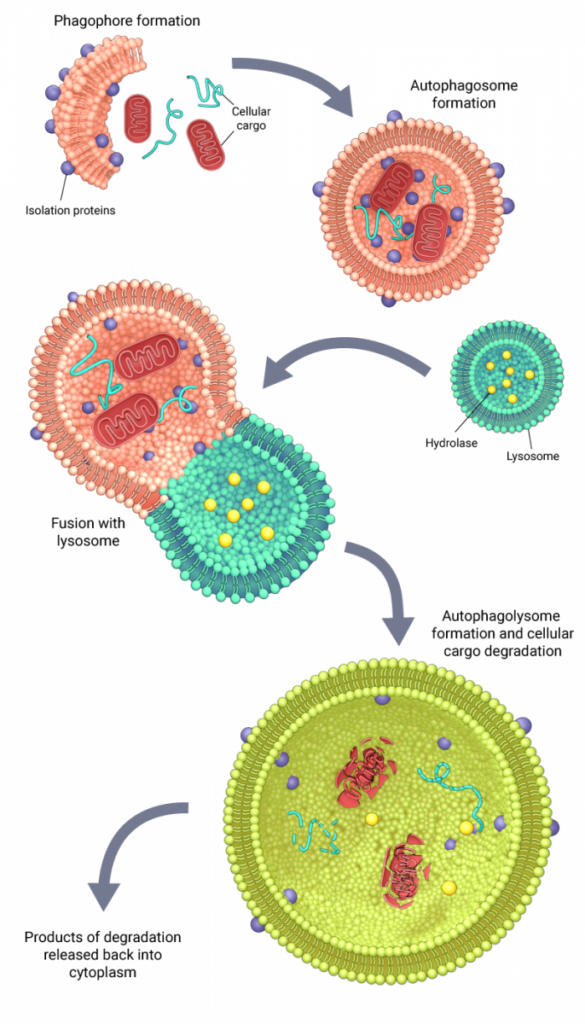
Autophagy, meaning self-eating, is an intracellular degradation system wherein unwanted cargo, such as old or damaged organelles, unneeded proteins, as well as pathogenic agents, are digested and the macromolecular contents from the digestion are released back into the cytosol [1]. First described in 1963 by Christian de Duve [2], autophagy involves the sequestration of cell organelles and cytoplasmic material into double-membrane vesicles called autophagosomes and their subsequent delivery to the lysosomes for degradation by the lysosomal hydrolases [1][3][4].

Mechanism of Autophagy

Autophagy in eukaryotes comprises of three different pathways, namely macroautophagy, microautophagy and chaperone-mediated autophagy. Although all of the three mechanistically different pathways culminate in the lysosomal degradation of cellular cargo, macroautophagy is the most extensively studied and is discussed here briefly [3].

Schematic depicting the mechanism of autophagy

The mechanism of macroautophagy is conserved among eukaryotes and is characterized by the encapsulation of cellular cargo into double-membrane vesicles called autophagosomes. In yeast, the formation of autophagosomes around the targeted cargo is mediated by autophagy-related (Atg) proteins that are recruited hierarchically to the phagophore assembly site or the preautophagosomal structure (PAS). At the PAS, initiator protein complexes facilitate the de novo synthesis of a double membrane structure called a phagophore or an isolation membrane, the lipid components for which are derived from the golgi-endosome system [4][5]. In mammals, where a distinct PAS-like structure has not been identified, multiple cellular organelles, including the plasma membrane, are known to serve as origins for the assembly of a phagophore [6]. Upon the recruitment of other Atg proteins, the isolation membrane gets extended into a phagophore, which eventually fuses at its free ends to form an autophagosome, which now surrounds and sequesters the cargo. Once formed, autophagosomes undergo a maturation process as they are transported along the endocytic pathway, before fusing with the lysosomes to form autophagolysosomes. The cellular cargo delivered by the autophagosomes are then degraded by the hydrolytic enzymes of the lysosomes and the products of degradation are released back into the cytoplasm for cell use [6][4].

The other two autophagy pathways do not require the formation of an autophagosome. In microautophagy, the lysosome directly engulfs portions of the cytoplasm [7], whereas in chaperone-mediated autophagy, specific chaperone proteins bind to the cargo and transport it across the lysosomal membrane for degradation [8].

Physiological relevance of Autophagy

Autophagy is a both a stress-management system and a means of homeostatic control in cells, and is therefore regulated differently under varying cellular conditions. For instance, in cells functioning normally under stress-free conditions, a basal level of autophagy ensures that old, damaged organelles and proteins are rapidly digested and that the contents from digestion are recycled back into the cytosol, so that the availability of cellular components are regulated for various cellular functions. But, in response to various types of cellular stresses such as nutrient starvation, oxidative stress, radiation or anticancer therapy, the autophagic machinery is upregulated in order to rapidly detoxify cells as well as to increase the recycling of cellular components to keep up with intensified cell function [9][10][11][12][13]. Furthermore, in normal physiology as well as under pathological conditions, autophagy is known to play a direct role in inhibiting apoptosis by regulating interactions between autophagy protein Beclin-1 and apoptosis regulator Bcl-2 [14][15]. However, in the absence of stringent spatio-temporal regulation, excessive autophagy can function as an alternative cell-death pathway [16]. Therefore, dysregulated autophagy has been associated with the onset and progression of diseases such as cancer, neurodegenerative and autoimmune disorders, and many more [17].

Mechanical stress and Autophagy

When autophagy is acting as a pro-survival mechanism primarily induced by stress, it can be naturally regulated by mechanical stresses such as compression, stretching or shear stress due to fluid flow. Consistent with this, a number of studies have highlighted how cells respond to mechanical stresses by regulating autophagy levels and how this could have implications in both physiological as well as pathophysiological conditions. For instance, in response to a mechanical stimulus such as exercise, the mineralization capacity of mechano-sensitive osteoblasts is stimulated, leading to enhanced bone formation and remodeling. In relation to this, recent studies on UMR-106 rat osteoblast cell line have shown an increase in autophagy during mineralization and suggested a link between low bone density and deficiency of the autophagy protein Atg5 [18]. Such studies are indicative of the role of autophagy in regulating bone remodeling in response to mechanical stimuli.

Another recent study has demonstrated that cells induce autophagy in response to compressive stresses. Following application of compressive forces of up to 1kPa, which is within the range of normal physiological forces experienced by cells, there was a transient increase in the rate of autophagosome formation [19]. This transient increase was suggested to function as a cellular stress management system until the cell is able to adapt to physical changes in their environment. On the other hand, excessive mechanical stresses can have an opposite effect, leading to suppression of autophagy. In a recent study by Carames et al, human and mouse cartilage explants subjected to high impact mechanical injuries underwent cell death, which was associated with a significant decrease in expression of autophagy markers. Interestingly, pharmacological stimulation of autophagy by rapamycin protected against cell death, highlighting the interaction between autophagy and mechanical stress in maintaining healthy cells [20].

References

  1. Benbrook DM, and Long A. Integration of autophagy, proteasomal degradation, unfolded protein response and apoptosis. Exp. Oncol. 2012; 34(3):286-97. [PMID: 23070014]
  2. DE DUVE C. The lysosome. Sci. Am. 1963; 208:64-72. [PMID: 14025755]
  3. Yang Z, and Klionsky DJ. Mammalian autophagy: core molecular machinery and signaling regulation. Curr. Opin. Cell Biol. 2009; 22(2):124-31. [PMID: 20034776]
  4. Polson HEJ, de Lartigue J, Rigden DJ, Reedijk M, Urbé S, Clague MJ, and Tooze SA. Mammalian Atg18 (WIPI2) localizes to omegasome-anchored phagophores and positively regulates LC3 lipidation. Autophagy 2010; 6(4):506-22. [PMID: 20505359]
  5. Ohashi Y, and Munro S. Membrane delivery to the yeast autophagosome from the Golgi-endosomal system. Mol. Biol. Cell 2010; 21(22):3998-4008. [PMID: 20861302]
  6. Abounit K, Scarabelli TM, and McCauley RB. Autophagy in mammalian cells. World J Biol Chem 2012; 3(1):1-6. [PMID: 22312452]
  7. Li W, Li J, and Bao J. Microautophagy: lesser-known self-eating. Cell. Mol. Life Sci. 2011; 69(7):1125-36. [PMID: 22080117]
  8. Cuervo AM, and Wong E. Chaperone-mediated autophagy: roles in disease and aging. Cell Res. 2013; 24(1):92-104. [PMID: 24281265]
  9. Onodera J, and Ohsumi Y. Autophagy is required for maintenance of amino acid levels and protein synthesis under nitrogen starvation. J. Biol. Chem. 2005; 280(36):31582-6. [PMID: 16027116]
  10. Kurihara Y, Kanki T, Aoki Y, Hirota Y, Saigusa T, Uchiumi T, and Kang D. Mitophagy plays an essential role in reducing mitochondrial production of reactive oxygen species and mutation of mitochondrial DNA by maintaining mitochondrial quantity and quality in yeast. J. Biol. Chem. 2011; 287(5):3265-72. [PMID: 22157017]
  11. Lee J, Giordano S, and Zhang J. Autophagy, mitochondria and oxidative stress: cross-talk and redox signalling. Biochem J 2012; 441(2):523-40. [PMID: 22187934]
  12. Fouillet A, Levet C, Virgone A, Robin M, Dourlen P, Rieusset J, Belaidi E, Ovize M, Touret M, Nataf S, and Mollereau B. ER stress inhibits neuronal death by promoting autophagy. Autophagy 2012; 8(6):915-26. [PMID: 22660271]
  13. Yorimitsu T, Nair U, Yang Z, and Klionsky DJ. Endoplasmic reticulum stress triggers autophagy. J. Biol. Chem. 2006; 281(40):30299-304. [PMID: 16901900]
  14. Decuypere J, Parys JB, and Bultynck G. Regulation of the autophagic bcl-2/beclin 1 interaction. Cells 2012; 1(3):284-312. [PMID: 24710477]
  15. Wang Z, Shi X, Yin J, Zuo G, Zhang J, and Chen G. Role of autophagy in early brain injury after experimental subarachnoid hemorrhage. J. Mol. Neurosci. 2011; 46(1):192-202. [PMID: 21728063]
  16. Maiuri MC, Zalckvar E, Kimchi A, and Kroemer G. Self-eating and self-killing: crosstalk between autophagy and apoptosis. Nat. Rev. Mol. Cell Biol. 2007; 8(9):741-52. [PMID: 17717517]
  17. Jiang P, and Mizushima N. Autophagy and human diseases. Cell Res. 2013; 24(1):69-79. [PMID: 24323045]
  18. Nollet M, Santucci-Darmanin S, Breuil V, Al-Sahlanee R, Cros C, Topi M, Momier D, Samson M, Pagnotta S, Cailleteau L, Battaglia S, Farlay D, Dacquin R, Barois N, Jurdic P, Boivin G, Heymann D, Lafont F, Lu SS, Dempster DW, Carle GF, and Pierrefite-Carle V. Autophagy in osteoblasts is involved in mineralization and bone homeostasis. Autophagy 2014; 10(11):1965-77. [PMID: 25484092]
  19. King JS, Veltman DM, and Insall RH. The induction of autophagy by mechanical stress. Autophagy 2011; 7(12):1490-9. [PMID: 22024750]
  20. Caramés B, Taniguchi N, Seino D, Blanco FJ, D'Lima D, and Lotz M. Mechanical injury suppresses autophagy regulators and pharmacologic activation of autophagy results in chondroprotection. Arthritis Rheum. 2011; 64(4):1182-92. [PMID: 22034068]

Sent from my iPhone

Thursday, November 27, 2025

Achievement Levels


Achievement Levels 

The PSLE Achievement Levels (AL) system, introduced in 2021 by the Ministry of Education (MOE), is designed to appreciate and measure a student's individual performance and subject mastery rather than ranking them against their peers. This shift aims to reduce unhealthy competition and stress, fostering a more holistic approach to education. 

Understanding the Achievement Levels

Students receive an AL score from 1 to 8 for each of their four PSLE subjects (English, Mathematics, Science, and Mother Tongue Language), with AL 1 being the highest level of achievement. 

AL 

Mark Range (Standard Level)

Achievement Description

1

90 and above

Outstanding achievement

2

85 – 89

Very good achievement

3

80 – 84

Good achievement

4

75 – 79

Above average achievement

5

65 – 74

Average achievement

6

45 – 64

Below average achievement

7

20 – 44

Marginal achievement

8

Below 20

Needs improvement

The total PSLE score is the sum of the ALs for all four subjects, with the best possible total score being 4 (four AL 1s) and the lowest being 32. 

Appreciating Achievement

The MOE designed this system to recognize a wide range of achievements and guide students to suitable secondary school pathways. 

  • Focus on Individual Progress: The system encourages a focus on the student's personal learning journey and improvement, rather than fine-tuned comparison with classmates.

  • Less Fine Differentiation: The use of broader scoring bands means that small mark differences do not lead to different ALs, reducing the stress associated with chasing a single point.

  • Holistic Development: The new system aligns with the educational goal of nurturing well-rounded individuals who can explore their interests in arts, sports, and other co-curricular activities (CCAs).

  • Informed School Choices: With fewer possible total scores (29 possibilities from 4 to 32), more students will share the same score, offering a wider range of schools to choose from based on factors beyond just academic performance, such as school culture, niche programs, and CCAs. 

Parental Role in Appreciation

Parents can support their child's learning and appreciate their results by: 

  • Fostering a growth mindset: Encourage the child to view mistakes as learning opportunities and emphasize effort and resilience over perfection.

  • Setting realistic goals: Help set achievable targets based on the child's strengths and weaknesses, focusing on steady progress.

  • Celebrating small wins: Acknowledge improvements in understanding concepts or developing better study habits, not just final scores.

  • Maintaining open communication: Discuss concerns and achievements in a supportive manner with the child and their teachers. 

Ultimately, the goal is to ensure students understand that their self-worth extends beyond a test score and that the PSLE is just one milestone in their lifelong learning journey. For more details, parents can consult the official MOE website on the PSLE scoring system. 


https://www.moe.gov.sg/microsites/psle-fsbb/psle/main.html

____


My take on AL score in relation to Mathematics Learning


The principle of aircon

https://www.instagram.com/reel/DQ8Vv39jK3v/?igsh=ZDUwejZkOXozMWp5


Sent from my iPhone